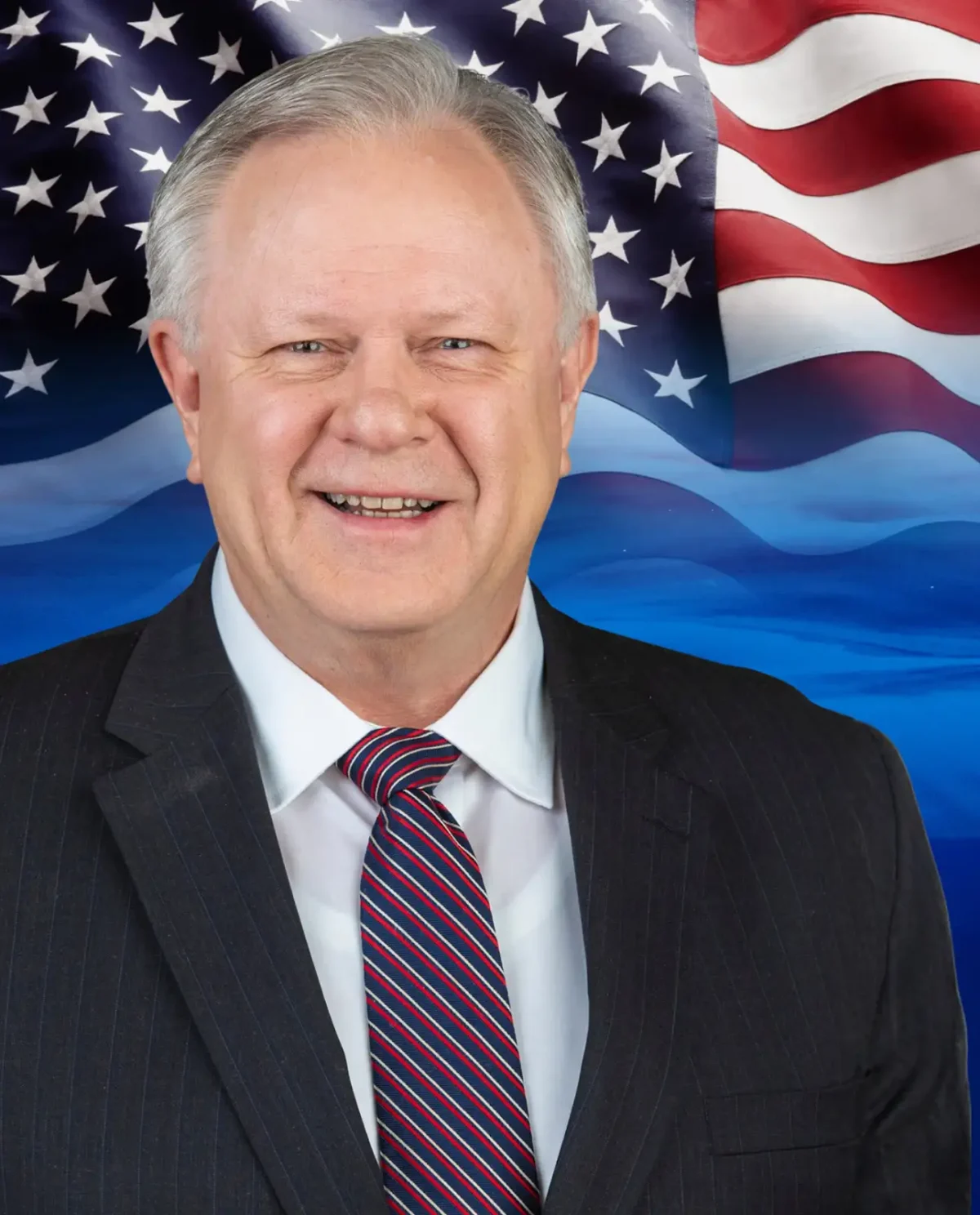

I was born in Rigby, Idaho, and grew up working on a potato farm, which instilled a strong work ethic. I studied Real Estate Finance and Business at Boise State and BYU, and have spent decades in real estate and marketing. As a husband, father, and grandfather, I’m committed to Idaho’s future. I’ve served as Idaho State Senator and Majority Leader, chaired the Human Resources Committee, and worked on key committees. As Executive Director of the Idaho Housing and Finance Association, I expanded housing programs and improved operations. I remain active in the Republican Party and aim to serve Idahoans with responsible, commonsense leadership.
Idaho GOP Platform Responses
✓+ Strongly Agree ✓ Somewhat Agree O Somewhat Disagree X Strongly Disagree
| Topic | Candidate’s Explanation | |
| ✓+ | Responsibility in Government | N/A |
| ✓+ | Citizen Involvement | N/A |
| ✓+ | Education | N/A |
| ✓+ | Agriculture | N/A |
| ✓+ | Water | N/A |
| ✓+ | Natural Resources / Environment | N/A |
| ✓+ | Energy | N/A |
| ✓+ | Idaho National Lab | N/A |
| ✓+ | Private Property Rights | N/A |
| ✓+ | State / Federal Lands | N/A |
| ✓+ | Wildlife | N/A |
| ✓+ | Economy | N/A |
| ✓+ | Health and Welfare | N/A |
| ✓+ | American Family | N/A |
| ✓+ | Older Americans | N/A |
| ✓+ | Law & Order w/ Justice | N/A |
| ✓+ | Securing the Border | N/A |
| ✓+ | Election of Idaho Judges | N/A |
| ✓+ | Religious Liberty | N/A |
Survey and Interview Responses
How long have you lived in Ada County?
50 years
How long have you been a Republican? Any prior party affiliation?
I’ve always been a Republican.
Have you been involved with any political organizations? (IACI, Idaho Majority Club, IFF, etc.)
I’ve attended political events, including with some of these organizations and I’ve attended several March for Life events at the State Capital.
Have you supported candidates from another party?
No
Why are you running for this office?
To continue the work I’ve started at the County and keep taxes as low as possible.
Have you held elected office before?
Yes, State Senator and County Commissioner.
What makes you qualified for this role?
I fully understand the proper role of Government.
If elected, what 2-3 actions do you intend to pursue in your first year?
Continue to advocate for the best possible government for the lowest possible taxes.
How have you served your community (boards, nonprofits, etc.)?
As Executive Director at Idaho Housing and Finance Association I implemented streamlined lending policy along with the Family self-sufficiency program.
Do you consider yourself fiscally conservative?
Yes, I keep taxes as low as i can and provide the best services possible.
Do you consider yourself socially conservative?
Yes! In every way.
Share your one-minute elevator speech.
I never planned to be a county commissioner, but six years ago I was asked to fill a vacancy in District 2. Local government matters. When we took office in 2021, Democrats controlled Ada County—they raised taxes and ran up debt. We stopped that, saved Expo Idaho from being sold, and are turning it into a major community asset. We’re building a huge park with zero local property tax dollars, brought in pro soccer (first game was a sellout), and we’ve actually cut property taxes while maintaining services. That’s what we’re focused on—delivering results without tax increases.
What are your top three priorities, and what would you act on first?
My top priorities are to keep doing what we’re doing well. First, make sure the new park at Expo Idaho opens successfully in mid-October and runs smoothly. Second, ensure the fair continues to thrive. Third, keep our county-wide EMS services properly funded and equipped. Overall, it’s about fulfilling the proper role of government—keeping people safe while limiting property tax increases as much as possible.
How will you balance protecting open space, agricultural, and rural lands against growth pressures?
We’ve already taken strong steps. We updated our zoning code to prohibit solar farms on agriculturally significant land—both statewide and locally. Our zoning is ambitious about protecting open space. When reviewing subdivision applications, we always ask how much open space the project will preserve. We’re actively safeguarding rural character while managing growth.
Is growth paying for growth in Ada County today?
No, growth is not fully paying for itself, largely because the legislature hasn’t given counties the tools we need. We do have impact fees in unincorporated areas, Star, and Eagle, but not yet in Boise, Meridian, Kuna, or Garden City. We can’t force cities to collect them for us—we have to ask. We’re making progress: Kuna and Garden City are scheduled soon. We’re pushing hard for Meridian and Boise too. The legislature also limits how much revenue we can capture from growth.
How will you ensure new development matches infrastructure capacity, especially water, sewer, and roads?
When we review projects, one of the first questions is: “Where is your water coming from?” They must prove a reliable source. For roads, we defer to the Ada County Highway District—they review every application. On sewer, we just convinced Boise to open up long-closed lines south of the freeway (over 500 acres of infill opportunity). Those lines have been there since the 80s/90s but were locked since 2014. Now property owners can hook up—which allows great infill without new annexation.
With rising budget pressure, where would you cut spending, where would you invest, and when would you raise taxes or fees?
This year we actually cut the budget by $1.85 million year-over-year. However, the state legislature reduced our revenue sharing (taking money off the top of sales tax and liquor tax), forcing a 2.9% property tax increase just to balance the books. 91% of our budget is mandated by the state (courts, jail, sheriff, felonies, etc.). We’re trying to protect taxpayers, but the state keeps shifting costs to local property taxes. We cut where we could; the rest is mostly out of our hands.
What is your position on jail expansion, public safety infrastructure, and county responsibility for mental health and addiction pressures?
The Ada County Jail is chronically overcrowded, largely because the state leaves 70–150 convicted inmates here (paying us only $80/day while it costs ~$130). We subsidize the state heavily. We’re remodeling the kitchen (serving 3,000+ meals/day) and preparing infrastructure for future expansion. On addiction, we have an excellent 20,000 sq ft treatment center. Judges can sentence non-violent felony offenders there instead of jail. The graduation ceremonies are powerful—lives really change. I invite you to attend one.
What should Ada County’s role be in homelessness, behavioral health, and treatment services—especially when priorities differ from cities?
We differ from Boise’s “low-barrier” approach. We support the Boise Rescue Mission model—requiring treatment for addiction and helping people move from homelessness to productive lives. We stopped funding New Path ($375k) because it provided housing without requiring participation. Instead, we’re helping the Rescue Mission by funding two positions at Terry Riley to increase treatment capacity. We also run the Ada County Victim Services Center (sexual abuse, domestic violence, etc.) in partnership with local nonprofits—at no extra cost to taxpayers.
Where does the county most need better coordination with ACHD, cities, emergency services, and the sheriff, and how would you improve it?
We coordinate well where we can, but many entities are independent (ACHD runs roads/bridges, fire districts are separate, cities have their own priorities). We run 911 dispatch and countywide EMS/ambulances, so coordination there is strong. We send every zoning application to ACHD and work with cities on impact fees and shared issues. Improvement is limited because we can’t dictate to independent agencies, but we maintain good working relationships and prioritize communication.
What is your plan to control Norwegian and roof rats?
We helped push two pieces of legislation this session. One failed, but one passed. We contribute $10,000 to federal wildlife management and will push to redirect it toward rat control. Our weed and pest team is excellent. The main strategy is monitoring rat populations so private pest control companies can respond effectively.
How would you ensure rural and unincorporated residents are heard earlier and more meaningfully in county decisions?
We already notify everyone within a set radius by mail, post signs on the property, and publish in the newspaper for any planning/zoning matter. Hearings are public. We also have an active PIO and social media outreach. I’m open to suggestions—if you have ideas for better engagement, I’d like to hear them.
What is your standard for transparency and constituent service, and how will you keep voters informed when they disagree with you?
Ada County is one of the most transparent governments in the state. Every expenditure is online down to the penny. We pioneered “Voter Verify”—anyone can see every ballot cast in any precinct or district after certification (without names). On constituent services, we help with code enforcement, weeds, etc., but if it’s a pending quasi-judicial matter, we can’t discuss it to remain impartial. Most constituents support our direction.
Is there an issue or anything not being talked about that you feel is important and want to mention?
Yes—the landfill. We’re required by law to maintain it and comply with strict environmental rules (including capturing and cleaning methane gas for energy). Republic Services built a competing landfill in Elmore County and is diverting significant volume, hurting our revenue (an enterprise fund with no property tax support). We’re negotiating with cities to protect the flow we need. Also, worth repeating: we cut the budget $1.85 million this year but still had to raise property taxes slightly due to state cuts in revenue sharing.